
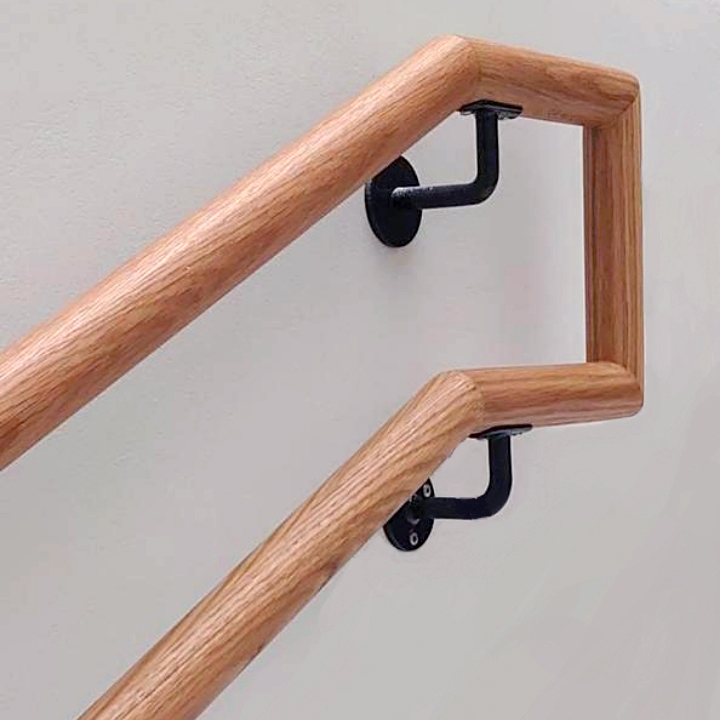
A wooden handrail is a practical, aesthetic and durable choice for stairs or hallways. It brings warmth and natural atmosphere to the space, while providing a supportive grip surface that doesn’t feel cold like metal or plastic. High-quality wooden handrails for stairs are manufactured from quality wood species that withstand daily use for decades when properly maintained. They can also be shaped and finished to match the space’s other interior design or architecture, making them popular in both traditional and modern projects.
Why is a wooden handrail an excellent choice for stairs?
A wooden handrail offers a unique combination of functionality, aesthetics and comfort. As a natural material, wood feels warm to the touch in all conditions, making it pleasant to use year-round – unlike metal, which can feel cold in winter or hot in summer.
A wooden handrail is also an aesthetically versatile solution. It suits countless interior styles from rustic to modern and can be finished to match exactly the space’s other wood tones or interior elements. The design possibilities for handrails are virtually limitless – available are both traditional round models and more special profiles designed according to customer wishes.
Additionally, a wooden handrail offers excellent grip, as wood’s natural surface provides good hold even with wet hands. This makes wooden handrails an excellent choice especially for homes with children or elderly people.
From a durability perspective, properly surface-treated wood maintains its functionality and appearance for years. A quality wooden handrail is an investment that serves long and ages beautifully.
Which wood species are best suited for handrails?
The wood species best suited for handrails are hard and durable varieties that maintain their shape and withstand wear. Among Finnish wood species, oak is one of the most popular options due to its excellent durability and distinguished appearance. Oak is hard and dense wood that withstands wear, impacts and moisture well.
Ash is another excellent option for handrails. It is almost as hard as oak, but slightly lighter in tone. Ash is also somewhat more flexible, making it easier to work into curved shapes.
Birch is a Finnish classic that suits handrails well, especially in spaces favoring light and Scandinavian style. It is somewhat softer than oak or ash, but with proper surface treatment it too can be made into a durable handrail.
Other good options include:
- Pine – affordable but softer option, suitable for locations with less wear exposure
- Beech – hard and durable, uniform wood for handrails
- Maple – light and hard wood species with beautiful texture
When choosing wood species, consider the space’s purpose, stress on the handrail and of course visual preferences. For public spaces and busy homes we recommend the hardest wood species, such as oak and ash.
How safe is a wooden handrail compared to other materials?
A wooden handrail is a very safe option and in many respects even safer than other commonly used materials. Wood’s natural surface provides excellent grip between hand and handrail, which is essential for safety – especially compared to shiny metal or plastic alternatives that can be slippery.
A significant safety advantage of wooden handrails is their thermal properties. Wood doesn’t conduct heat efficiently, so it always feels pleasant to touch regardless of ambient temperature. Unlike metal, wood never feels unpleasantly cold in winter or hot in direct sunlight. This property makes wooden handrails an excellent choice especially for areas exposed to extreme conditions.
In terms of durability and load-bearing capacity, a properly installed wooden handrail meets all safety standards. A properly dimensioned and quality wooden handrail withstands the same loads as other materials. Additionally, wood can be easily shaped ergonomically to suit different hands, which increases comfort and safety.
A wooden handrail also doesn’t contain sharp corners or edges, which reduces injury risk. The wooden surface is always warm to touch and feels pleasant in hand, which encourages people to actually use the handrail when moving on stairs.
How is a wooden handrail installed correctly?
Proper installation of a wooden handrail is important for both safety and durability. Installation begins with the correct height: according to standards, the optimal height for handrails is generally 900-1000 mm measured from the stair nosing. In public spaces, a dual-level handrail (700 mm and 900 mm) may be necessary to meet accessibility requirements.
Attachment typically occurs to the wall or stair posts with handrail brackets. The distance between brackets is generally 800-1000 mm, depending on the handrail’s thickness and application. In heavier load applications, bracket spacing can be reduced.
Tools and materials needed for installation:
- Drill and appropriate drill bits for wall material
- Screwdriver and screws
- Spirit level to ensure straightness
- Measuring tape and pencil
- Appropriate fasteners according to wall material (concrete screws, anchor-mounted screws, wood screws)
- Handrail brackets
Considering wall material is essential: drywall always requires sturdy fasteners or attachment to framing, brick walls suit wedge anchors, and wood walls need long wood screws. When the handrail terminates at a wall or post, it should be shaped so that clothing or bags cannot catch on it.
In curved staircases, handrails can be manufactured either by laminating thin layers together or using steam bending. Installation of such special solutions is often best left to professionals.
How is a wooden handrail maintained and serviced?
Regular maintenance of wooden handrails extends their service life and preserves their beautiful appearance. Basic maintenance includes regular cleaning of dust and dirt with a slightly dampened cloth. Avoid overly wet cleaning and strong cleaning agents that can damage wood or its surface treatment.
Refinishing the surface treatment is the most important maintenance procedure. An oiled or waxed handrail generally needs new treatment every 1-3 years, depending on usage amount and conditions. A lacquered surface is more durable, but its condition should also be checked regularly and renewed when necessary. Steps for refinishing surface treatment:
- Clean the handrail thoroughly of dust and dirt
- Sand lightly with fine sandpaper (e.g., 240 grit)
- Remove sanding dust thoroughly
- Apply a new coat of oil, wax or lacquer according to manufacturer’s instructions
- Allow to dry undisturbed for the time specified in usage instructions
If the handrail gets scratches or dents, they can usually be repaired locally by sanding the damaged area and renewing the surface treatment. Deeper damage can be filled with wood filler before sanding and surface treatment.
Also remember to regularly check the handrail’s fastenings and brackets. Loose screws should be tightened immediately to ensure safety.
What should be considered when choosing a wooden handrail?
When choosing a wooden handrail, there are several important factors that affect both practicality and aesthetics. First, consider the space’s style and other interior design – the handrail should harmonize with the space’s other wood materials and color tones. Finnish wood is an excellent choice for handrails due to its high quality and durability.
The intended use partly determines material selection: in public spaces or families with small children, it’s worth choosing an especially durable wood species and surface treatment. Also consider the handrail’s profile – it should be pleasant and supportive in hand. The most common diameter is about 40-50 mm, but this can vary according to users and space style.
Surface treatment significantly affects both appearance and maintenance requirements. Options include:
- Lacquers – durable and easy to maintain, but may become glossy
- Oils – enhance wood’s natural beauty and feel, but require regular maintenance
- Waxes – provide natural appearance and good protection, fairly easy to maintain
Budget is naturally also a consideration. Handrail price is affected by wood species, design, surface treatment and installation method. Over the long term, however, a quality wooden handrail is a durable investment that maintains its value and functionality for decades.
We manufacture wooden handrails always from high-quality Finnish wood species. Each handrail is made according to customer wishes, individually dimensioned and finished. We combine traditional woodworking methods with modern technology, ensuring precise and quality results.
Would you like to know more or request a quote? Feel free to contact us!